The Trojan Horse: How Category Creators Sell the Future by Calling It the Present
Why the best category creators of the last twenty years hid their breakthroughs inside familiar categories — and how to engineer the same move for your novel product.
Don't sell the future. Sell the past. Deliver the future as a surprise.
CEO & Founder, Arnen ·
The smartest thing a category-creating founder ever did was act like they weren't creating one.
On July 31st, 2013, two weeks before Slack's preview release, Stewart Butterfield sent his team a 1,400-word internal memo titled "We Don't Sell Saddles Here." The memo is widely cited for one line — "What we are selling is not the software product. We're selling organizational transformation." — and that citation is misleading on its own. The load-bearing claim is buried two paragraphs earlier:
"The reality is that selling improvements over the current state of things — even if better, faster, and cheaper — is incredibly hard. People are happy with their lives. They are content with the way things are. They are not looking for a better thing. People do not want our software."
People do not want your breakthrough. They are content with how things are. Butterfield's actual strategic move, the one he ran for the next decade, was to be internally clear about the breakthrough (organizational transformation) while externally wrapping it in a container the market already understood: chat. The Trojan Horse went inside the city by looking like a gift the city was already expecting.
This is the paradox every category-creating founder eventually encounters, usually after burning two quarters of runway evangelizing a category that does not exist. The market does not want your breakthrough. It wants something familiar enough to recognize, with a hidden door that opens onto something it has never seen.
This is the Trojan Horse.
The pattern is buried in the founding stories of every category-defining company of the last twenty years. Snowflake sold itself as a data warehouse. Slack sold itself as a chat app. Figma sold itself as Sketch in the browser. Stripe called its first product /dev/payments. Each of these companies was doing something the market had no vocabulary for. And in every case, the founders refused to lead with the breakthrough. They led with the container that buyers already had budget for, language for, and reflexes for. The breakthrough was inside.
This piece is about why that pattern works, when it fails, and how to engineer it for a product the market has never seen.
Part 1: Why the Brain Treats Familiar as True
Consider the move Butterfield actually made. When Slack launched in 2013, the obvious competitor was HipChat — same category, same buyer, same price band. Butterfield ignored it. He named email as the real competitor instead. The reframe worked: buyers heard "email replacement" and instantly had budget urgency, comparison reflexes, and a category they could explain to their boss. Naming HipChat would have produced a niche-tool fight; naming email produced a productivity-infrastructure decision. Same product, two different competitive frames, radically different outcomes.
Why does the brain process email as a more powerful frame than HipChat, when HipChat is the technically more accurate comparison? Three findings from cognitive science explain why the Trojan Horse is not a marketing trick but a load-bearing accommodation for how the human brain processes new categories.
In 1999, Rolf Reber and Norbert Schwarz showed people identical statements written in two different colors against a white background. Some saw the statement in high-contrast text. Others saw it in low-contrast text that took marginally more visual effort. Then they asked: is this statement true? The high-contrast version was rated more often as true. Same words, different fonts, different truth values. Reber and Schwarz called this processing fluency: the more easily your brain processes a piece of information, the more it treats that information as familiar, credible, and beautiful. Disfluency registers as subtle discomfort. Buyers cannot articulate it. They experience it as vague disinterest — the most expensive emotion a buyer can have toward your product.
Eleanor Rosch's prototype theory, developed at UC Berkeley in the 1970s, showed that the brain does not categorize things by their formal definitions. It categorizes by resemblance to a prototype. A robin is judged more typical of "bird" than a penguin, even though both qualify. When a buyer encounters your pitch, they are not asking what is this? They are asking what does this resemble? If nothing in their prototype library matches, the brain files you under unknown, and unknown is where attention goes to die.
Dedre Gentner's structure-mapping theory, developed at Northwestern, formalized how the brain reaches for analogies. In a well-known persuasion study, participants were given a new scenario and offered analogies that were either surface-similar (familiar shape, different structure) or structurally similar (different surface, same deep structure). Seventy percent reached for surface similarity. Only thirty percent reached for structural truth. The brain treats familiar surface as a faster, cheaper signal than deep structural analysis. Founders who insist on educating buyers about their structural innovation are fighting a 70/30 cognitive battle, and they are on the wrong side of the ratio.
Butterfield's choice to name email rather than HipChat was not creative positioning. It was structural literacy about how a buyer's brain actually processes new categories. The Trojan Horse stops looking like a positioning tactic and starts looking like the only honest way to communicate with a buyer's actual cognitive architecture.
Part 2: The Trojan Horse Formula
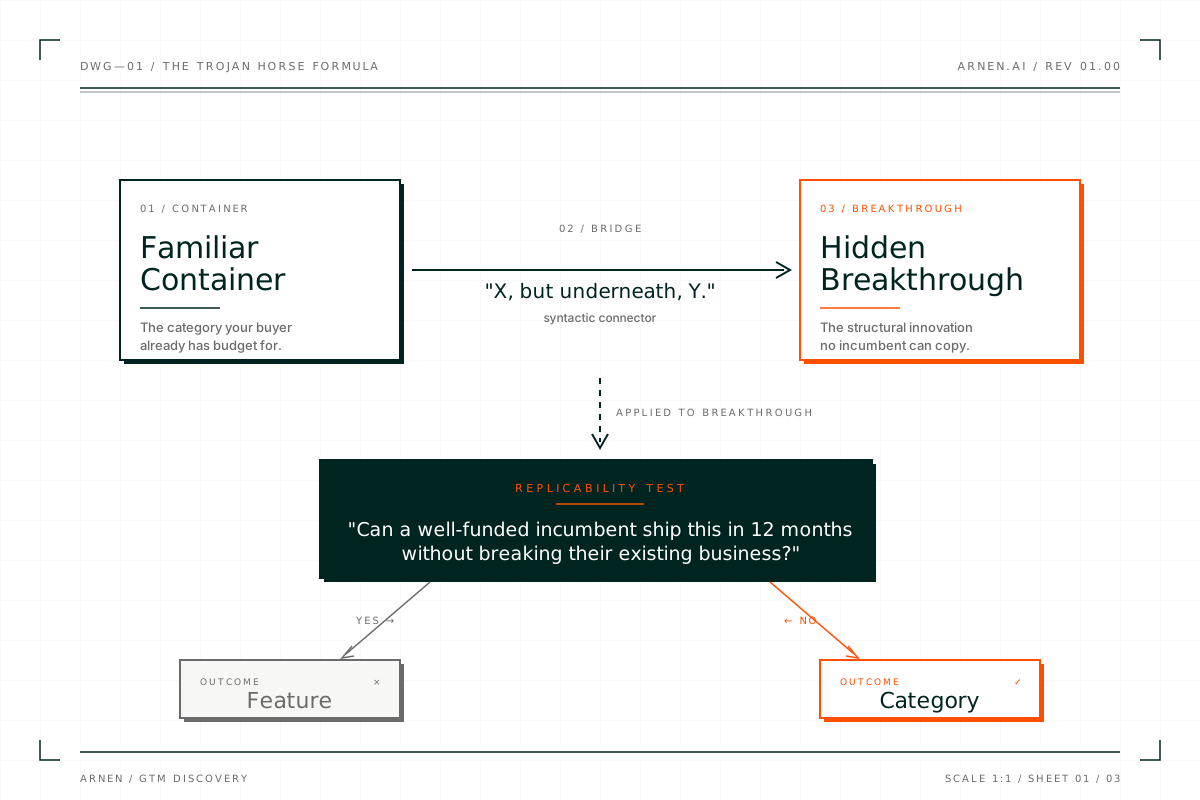
Three components, one bridge.
The Familiar Container is the category your buyer already recognizes. It has known features, known price ranges, and an existing line item in their budget. CRM. Email. Database. Chat. Monitoring. Payment processor. The container does the cognitive heavy lifting. It tells the buyer's brain: this is a thing I understand.
The Hidden Breakthrough is what you actually built. It is the structural innovation that no incumbent in the familiar category can replicate. Real-time collaboration. Multi-tenant cloud architecture. Developer-first API design. Consumption pricing tied to actual compute. The breakthrough is what gives you the moat. It is also what makes the product hard to explain.
The Bridge is the syntactic connector. "We look like X, but underneath we are Y." "It's X for Y." "It's X, plus Z." Without the bridge, the container and the breakthrough sit beside each other as unrelated claims, and the buyer's brain treats the second as marketing puffery.
The pattern, rendered as a schematic:
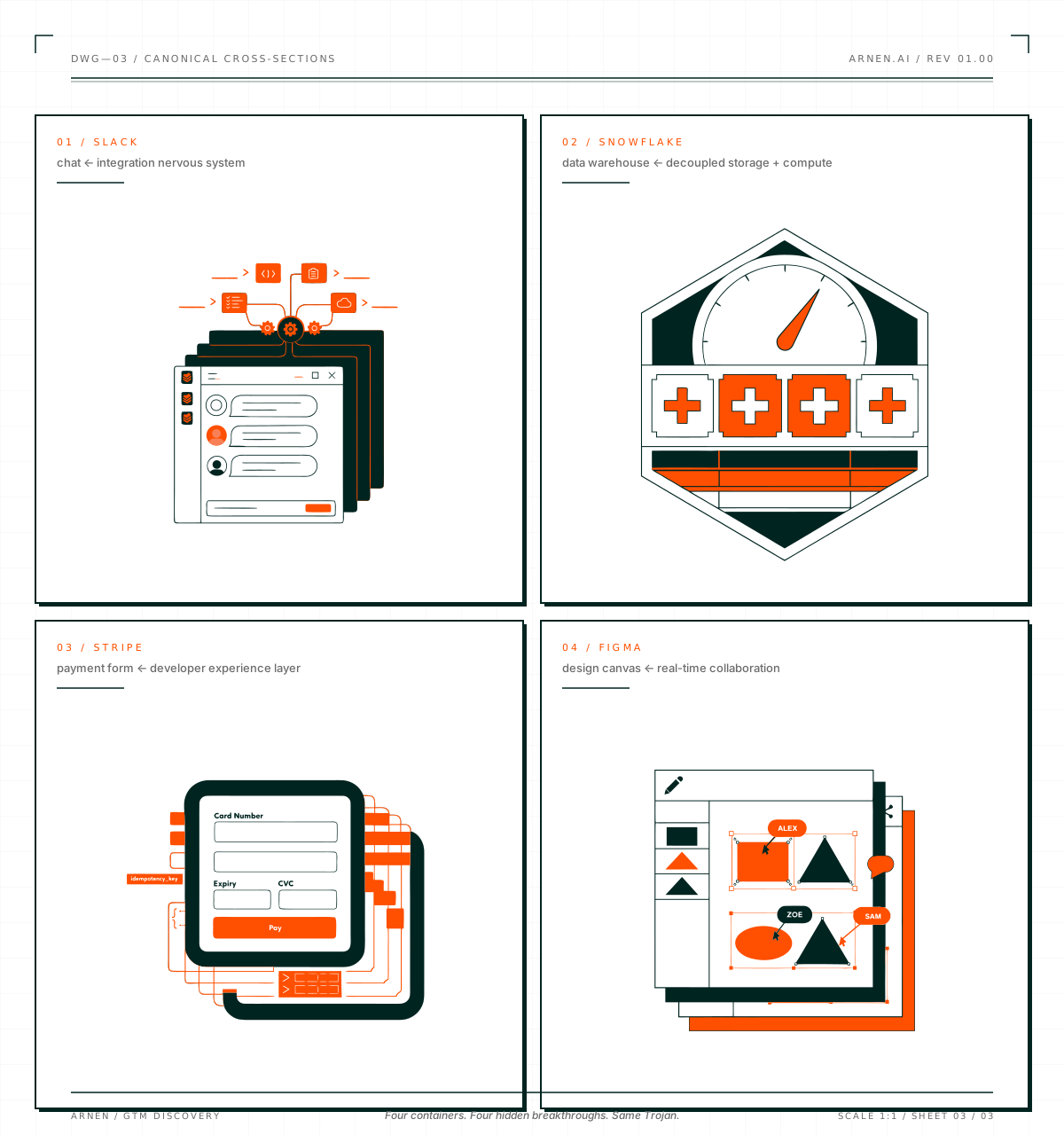
Across the canonical cases — team chat (Slack), cloud data warehouse (Snowflake), payment processor for developers (Stripe), Sketch in the browser (Figma) — the same formula operates through different mechanical levers. Each one-liner is under ten seconds. None leads with the breakthrough. All keep the breakthrough close enough to surface in the first conversation. The familiar container creates the cognitive on-ramp. The hidden breakthrough creates the moat.
The Replicability Test. Before reading further, hold every Trojan in this piece against one question: can a well-funded incumbent in the familiar category ship the breakthrough in twelve months without breaking their existing business? If yes, it is a feature. If no — and you can name the structural reason — it is a category.
Why AI doesn't change this. A reasonable objection: with AI, can't an incumbent ship anything in twelve months? Not the part that matters. AI compresses implementation cost; it does not compress sales-comp restructure, channel conflict, or P&L cannibalization. Adobe could have built Figma's renderer at any point in the last eight years — the unwinnable fight was making real-time browser-based design coexist with Creative Cloud's desktop-license economics. They tried to buy the company for $20 billion and were blocked. Salesforce has shipped Einstein, Data Cloud, and Agentforce in the same window and has not killed Gong, Outreach, Clari, Apollo, or Snowflake — not because the engineering is hard, but because integrating any of them correctly would cannibalize Sales Cloud seat ARPU. The test was never about whether the incumbent could build it. It was about whether they could ship it without breaking what currently pays the bills. AI sharpens that question. It does not retire it.
Part 3: Slack — The Saddles Memo in Practice
The clearest case is the company that effectively invented the modern playbook.
When Slack launched its preview in 2013, the team chat category was not new. HipChat had existed since 2010. Campfire since 2006. IRC for decades. A founder leading with the breakthrough — we are building the operating system for organizational communication — would have spent three years explaining what that meant.
Butterfield refused both options. He neither led with the breakthrough nor accepted the existing team-chat frame. Instead, he reframed the competitive set. The competitor was not HipChat. The competitor was email. By framing email as the real incumbent, Slack converted itself from a $5/month niche chat tool into a productivity infrastructure decision that touched every department. The familiar container — chat — created the on-ramp. The competitive frame — email — created the urgency. The buyer's brain processed the comparison instantly because both elements were familiar.
Then came the integrations. By 2014, Slack had connectors for GitHub, Trello, JIRA, Salesforce, Google Drive, and dozens of others. From the outside, this looked like product breadth. Strategically, it was the reveal. Once a team was using Slack as a chat tool, the integration layer turned it into the central nervous system for work. The breakthrough — Slack as an enterprise collaboration platform with an integration moat, not merely a chat app — became visible to the buyer only after adoption. The buyer attributed the discovery to themselves rather than to the marketing. Self-attributed insights stick. Marketed insights do not.
The replicability filter held at the architectural level. Email is a protocol, not a platform, so no central party could ship a vendor-specific integration layer without breaking the federation that makes email interoperable. Microsoft eventually built Teams inside Office 365 — but that was a four-years-later parallel product, not a retrofit of the stated incumbent. The integration moat was protected by structural facts about the incumbent category, not by Slack's lead time alone.
Slack sold to Salesforce for $27.7 billion in 2020. The acquisition price was not for a chat app. It was for the integration layer the Trojan had quietly built underneath.
Three mechanical choices in the Slack play are replicable. First, Butterfield picked a container (chat) that did not map to a specific buyer budget — chat was free. He then anchored to a much larger budget category (email/productivity) by reframing the competitive set, giving the product an urgency anchor without forcing the buyer to recognize a new category. Second, the price point was deliberately small enough to expense without procurement involvement, lowering the cognitive cost of yes. Third, the reveal was designed into the product surface — integrations — so buyers discovered the breakthrough through use, not through marketing. None of these moves required inventing a new category from scratch. All three are available to any founder willing to study them.
Part 4: Three Variations on the Pattern
The same pattern produces different mechanical moves across cases. Three short comparisons.
Snowflake — Trojan as Budget Access. Benoît Dageville, Thierry Cruanes, and Marcin Żukowski founded Snowflake in 2012. The technical innovation — separating storage from compute, multi-cluster shared-data architecture, automatic micro-partitioning — appeared in their 2016 SIGMOD paper but nowhere in their go-to-market pitch. They sold the company as a data warehouse. The category had existed for thirty years. Every CIO had a line item for it. Snowflake's Trojan worked because the container gave them direct access to a budget that already existed — IT data warehouse spend — without asking the buyer to recognize a new category. The breakthrough (consumption pricing tied to actual compute) became visible only on the first monthly invoice. The replicability filter held at the business-model level: Teradata's revenue was built on $1–10M hardware-inclusive contracts billed in advance, and consumption pricing would have cannibalized the sales motion that justified the existing revenue base. Neither the architecture nor the comp plan could pivot inside twelve months. By the time competitors realized Snowflake was something architecturally different, the company had 168% net revenue retention and the largest software IPO in history.
Stripe — Trojan as Cultural Recruitment. Patrick and John Collison founded Stripe in 2010. They named their first product /dev/payments — a Unix-style joke that simultaneously said we are in the payments category and we know exactly who our buyer is. The pitch was not that they were rebuilding financial infrastructure. The pitch was that their payment processor worked with seven lines of code. The seven lines became the marketing artifact: short enough to tweet, concrete enough to validate, small enough to make PayPal's weeks of integration look indefensible. The Trojan was payments. The cultural signal — this product was built by people who understand developers — recruited the buyer. The hidden breakthrough was developer-experience-as-moat, which Stripe later compounded across Billing, Identity, Capital, Atlas, and Treasury. The replicability filter held at the organizational level: developer experience as a moat required a developer-first organization — engineering-led documentation, first-party SDKs, status pages, public API discipline. Bolting that onto PayPal, Authorize.net, or Braintree was not a roadmap problem; it was an org-design problem that would have required dismantling the sales-led structure each incumbent was built around. The $95 billion valuation is not a payments-company valuation.
Figma — Trojan as Feature-Level Expectation. Dylan Field and Evan Wallace started Figma in 2012 with the conceptual question what if design worked like Google Docs? When they launched publicly in 2016, the positioning was three words: Sketch in the browser. No mention of real-time collaboration. No mention of cloud-native architecture. Sketch was the prototype member of the design-tool category — the most typical instance — so positioning as Sketch but in the browser told designers exactly what features to expect. The reveal happened inside the product: cursor visibility, live commenting, share-by-link. The replicability filter held at the architectural floor: Sketch's local-file desktop model could not be retrofitted to real-time multiplayer state without dismantling the file format every Sketch user had built libraries against. Sketch + Plant and Sketch + Abstract bolted versioning on top, but neither could deliver true multiplayer because the storage model was fundamentally local. By the time competitors understood that Figma was a collaboration platform rather than a desktop tool replacement, the company had 77% UI design market share.
Three different mechanical levers — budget access, cultural recruitment, feature-level expectation — all instantiating the same pattern. The container varies. The principle does not.
Part 5: The Inverse Pattern — Salesforce and Tesla
Two famous category creators appear to have rejected the Trojan Horse. Marc Benioff launched Salesforce in 1999 with a marketing campaign called "No Software," complete with hired actors staging mock protests outside Siebel's user conference. Elon Musk launched Tesla in 2008 with the Roadster, a $98,950 electric sports car pitched on lithium-ion performance. Both appeared to lead with the breakthrough, not hide it.
Both are special cases of the same pattern.
Salesforce's "No Software" worked because it took the most familiar enterprise software category — CRM — and inverted exactly one attribute: installation. The buyer already had a CRM budget and a CRM mental model. Benioff did not ask the buyer to learn a new category. He asked them to remove one painful attribute from the familiar category. The Trojan container was still CRM. The breakthrough was a new delivery model, and the "No Software" branding made it impossible to miss. The inversion was the reveal.
Tesla's luxury sports car move worked because the Roadster category was small, the buyers were status-driven, and the breakthrough — a usable electric vehicle — needed to be demonstrated to a culture that associated electric cars with golf carts. Musk's published strategy was sequential: build a sports car, use that money to build an affordable car, use that money to build an even more affordable car. The Roadster's job was not to capture the sports car market. It was to convert the cultural prototype of "electric car" from embarrassing compromise to object of desire. Once the prototype shifted, the Model S could be sold into the familiar automotive category without the same prototype problem.
These bets are high-variance. They work when the founder has a dramatic enough product to instantiate a new prototype and the capital to absorb direct market education costs. For most category creators, the standard Trojan Horse is the safer bet.
Part 6: Anatomy of a Working Trojan Horse
Five structural requirements. A Trojan that fails any of them is not really a Trojan.
1. The container must have a buyer with existing budget. The most common founder error is picking a container that is conceptually familiar but does not map to a budget line item. Knowledge management is familiar but no enterprise buyer has it as a budget. Productivity tool is familiar but procurement has no category for it. Database has budget. CRM has budget. Payment processor has budget. Familiarity without budget is just vocabulary, and vocabulary does not close deals.
2. The container must survive a thirty-second pitch. If your buyer needs more than thirty seconds to recognize the container, you have not solved the on-ramp problem. The test: if a non-technical friend cannot accurately repeat what you do after one sentence, the container is not familiar enough. The fix is almost always to pick a smaller container, not to add more explanation. Sketch in the browser beats the future of design. Data warehouse beats cloud-native analytical compute platform.
3. The hidden breakthrough must be genuinely different. The Trojan does not work if there is no Trojan. Many founders pick a familiar container and describe their product as "the same thing, but better" — that is a me-too pitch, not a Trojan. The replicability test from the opening callout is the load-bearing version of this requirement: if a well-funded incumbent in the familiar category can ship the same thing in twelve months without breaking their business, you do not have a category to defend — you have a feature waiting to be commoditized.
4. The reveal must be designed, not assumed. The most subtle failure mode is the buried breakthrough — when the Trojan works so well that the buyer never discovers the underlying innovation. Slack designed the reveal into the integration layer. Figma into cursor visibility. Snowflake into the billing dashboard. Stripe into the developer documentation. Buyers who discover the breakthrough through experience attribute it to themselves and remember. Buyers who discover it through marketing forget.
5. You have to be willing to graduate. The Trojan is a temporary structure. At some point you need to stop renting credibility from the familiar category and start owning your own. Companies that fail to graduate get stuck inside the original container and never escape its margin structure. The graduation move is its own discipline — covered in Part 8.
Part 7: When the Trojan Horse Kills You
Four failure modes, four famous corpses.
Failure mode one: leading with the breakthrough when you cannot deliver. Magic Leap raised approximately $3.5 billion between 2014 and 2020 on the promise of augmented reality glasses that would change human perception. Founder Rony Abovitz's teasers — including a notoriously misleading whale-in-a-gymnasium video that was computer-generated rather than captured through the device — sold a breakthrough the company could not build. When the Magic Leap One launched in 2018, it was an incremental improvement over Microsoft HoloLens. The company sold roughly 6,000 units in six months against a target of one million. Abovitz stepped down in 2020. The failure was not that the ambition was too high. The failure was that there was no Trojan to fall back on — no familiar container, no smaller product to sell while the breakthrough caught up.
Failure mode two: a Trojan that breaks under actual usage. Quibi raised $1.75 billion and launched in April 2020 with a Trojan of premium short-form video for mobile. Within six months, the company shut down. The Trojan broke because the analogy did not survive contact with use. Premium video buyers, especially during the 2020 pandemic, watched on televisions. Mobile-only viewing violated the prototype. Paying a subscription for short-form video violated the prototype, since YouTube and TikTok had already set the expectation that short-form mobile video was free. The container created an expectation the product could not satisfy.
Failure mode three: failing to deliver on the container. Webvan pitched a familiar container — online grocery delivery — with a hidden breakthrough: $35-million automated warehouses, dedicated delivery fleets, and thirty-minute delivery windows. The Trojan worked at first: more than $800 million raised between 1997 and 1999, a $1.2 billion IPO in November 1999, expansion into nine metropolitan markets, and a $1 billion contract with Bechtel to build out fulfillment infrastructure. The collapse came when the container itself proved un-deliverable at the economics the container implied. Grocery buyers expected grocery-store prices; Webvan's actual cost per order ran north of $25 in cities without enough order density to amortize the warehouses. The company filed for Chapter 11 in July 2001, twenty months after the IPO. The Trojan only works if the container can be honored at the price the container itself implies.
Failure mode four: a container that commoditizes you. Juicero launched in March 2016 as a $699 connected juicer (cut to $399 in January 2017). The Trojan was kitchen appliance. The breakthrough was Wi-Fi connectivity, proprietary packs, and precision pressing. The killing blow came on April 19, 2017, when Bloomberg reporters demonstrated in a one-minute video that the proprietary packs could be squeezed by hand and produced identical juice. The Trojan container had created a comparison frame — squeezing produce — that the product could not survive. The breakthrough became visible inside an unflattering frame, and the company shut down later that year.
The four failures share a pattern. The Trojan is a tool for translating breakthroughs into the buyer's cognitive infrastructure. It is not a substitute for the breakthrough, not a substitute for delivering on the container, and not invariant to which container you pick.
Part 8: The Graduation Problem
The hardest decision in Trojan Horse positioning is when to drop the Trojan.
The familiar container is temporary. Once enough buyers have made the leap, the container starts to constrain you. Buyers compare you against the category prototype on price and features. Margin pressure leaks in from the old category. Analysts file you in the wrong Magic Quadrant. Competitors copy the surface of your container and force you into feature battles you should not be fighting.
The graduation moment is when the founder stops describing the company in the language of the old category and starts using a category name they invented. Gong did it in October 2019, dropping conversation intelligence for revenue intelligence. The shift moved Gong out of direct competition with Chorus.ai and ExecVision and into a category it could own. By the time competitors caught up to the conversation intelligence frame, Gong had a $7 billion valuation built on the distinction.
Drift took the same path. David Cancel has been explicit: "Drift wasn't the first live chat tool, so we made Conversational Marketing the category." The Trojan was live chat. The graduation was the 2019 book Conversational Marketing, co-authored with Dave Gerhardt. Within two years, HubSpot launched a Conversations product, Intercom rebranded around Conversational Experiences, and Salesforce added chatbots to Pardot. The competitors validated the new category by adopting Drift's language.
The graduation signal is quiet. You notice buyers have stopped asking how is this different from [incumbent] and started asking is this the only one of these? You notice analysts inventing acronyms for your category. You notice your own salespeople have stopped pulling up the comparison chart because there is nothing comparable to pull up. Slack went through this between 2014 and 2016: email killer became where work happens became digital headquarters. The chat container was the on-ramp. The digital HQ was the destination. The graduation is the difference between renting authority and owning it.
Part 9: Picking Your Trojan — Meridian, a Worked Example
For founders sitting with a novel product, here is the operating question: what is my Trojan Horse, and how do I pick it without lying to myself about it?
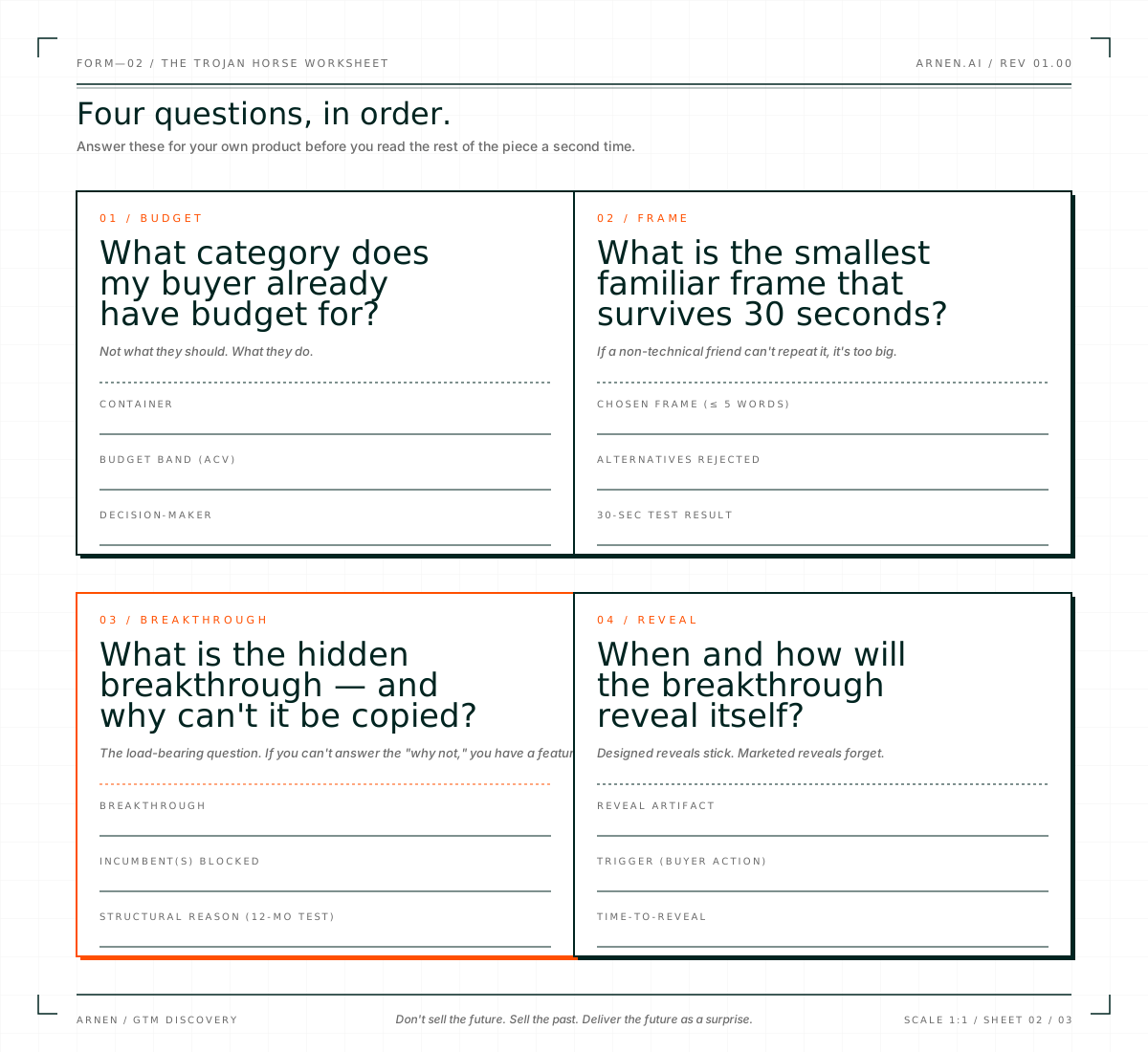
Four questions, in order. To make this concrete, the rest of this section walks a single fictional founder through all four. The company is invented; the structure is real; the specifics are composited from patterns visible across actual category-creating products. As you read, substitute your own product into each answer slot — the worksheet is the artifact, not the example.
Call the company Meridian. Meridian is an AI-native compliance product: it installs an agent into a company's production environment, continuously observes engineering activity, and autonomously generates the evidence required for SOC2, HIPAA, and ISO27001 audits. The buyer's compliance team does not collect screenshots, configure scopes, or attest to controls manually. Meridian does all of it. The category, strictly speaking, does not exist.
Question 1: What category does my buyer already have budget for?
Not what they should have budget for. Not what an enterprising VP could create a line item for if inspired. What is the existing budget category, owned by a known decision-maker, with a typical price band?
Meridian's answer: The buyer (CISO or VP Engineering) already pays $30K–$80K per year for compliance automation — Vanta, Drata, Tugboat Logic, Secureframe. Some also pay $50K–$200K to compliance auditors and consultants annually. The line item exists in the security budget. Container: compliance automation. Budget band: $30K–$80K ACV. Decision-maker: CISO.
If Meridian had answered "general purpose AI" or "engineering productivity," there would be no budget line to anchor to, and the rest of the worksheet would be premature. Familiarity without budget is not a Trojan; it is just vocabulary.
Question 2: What is the smallest familiar frame that survives a thirty-second pitch?
The temptation is to claim a bigger container because the breakthrough deserves it. Resist.
Meridian's candidates:
- "The future of compliance" — too vague, fails the thirty-second test.
- "AI-native compliance automation" — pulls in the budget category, but the buyer's brain has to construct a new sub-category for AI-native, raising disfluency.
- "Vanta on autopilot" — concrete, fluent, sub-five-second recognition. Maps directly to a product the buyer already evaluates.
- "The compliance platform that fills in the evidence for you" — concrete, but does not signal the depth of the breakthrough.
Chosen container: "Vanta on autopilot." Three words. Survives the test. Implies the buyer can compare features and pricing directly against Vanta in their next vendor review. The container is liquid — no buyer needs to be educated about what compliance automation is.
Question 3: What is the breakthrough hidden underneath, and why can no incumbent replicate it?
Be specific. The breakthrough is load-bearing only if there is a structural reason no incumbent can copy it in twelve months.
Meridian's breakthrough: An agent that runs inside the production environment, continuously observes engineering activity (deploys, access events, config changes, code review behaviors), and generates audit-ready evidence as a byproduct of normal operations. Vanta's evidence collection assumes a human uploading screenshots and attesting to controls. Meridian's evidence collection assumes zero human involvement after install.
Why Vanta cannot copy this in twelve months: Vanta's entire product surface, customer success playbook, and pricing model are built around the human-in-the-loop assumption. Their nine-figure ARR is sold on "we save your compliance team 80% of their time." Meridian's pitch is "we save your compliance team 100% of their time." Pivoting Vanta to autonomous evidence would break existing customers' workflows and contradict the value proposition that sells the existing contracts. The incumbent is structurally incapable of cannibalizing itself fast enough. This is the load-bearing test.
If Meridian could not pass this test — if Vanta could plausibly ship the same feature in twelve months without breaking its core business — there is no Trojan to build. The product is a feature, not a category.
Question 4: When and how will the breakthrough reveal itself?
Design the reveal moment. Do not assume buyers will figure it out from marketing.
Meridian's reveal: Within twenty-four hours of installation, the buyer's compliance dashboard hits a 90% audit-readiness score across SOC2 Type II controls. Vanta customers typically take six weeks to reach the same score, and the work is performed by humans inside their team. The reveal is the dashboard, on day one, with a number nobody in compliance has seen that fast before. The buyer's compliance lead sees the score, refreshes the page assuming something is broken, then opens a ticket asking how it happened. That ticket is the moment of self-attributed discovery.
The resulting positioning artifact:
Meridian is Vanta on autopilot. We replace the screenshot-and-attest workflow with an agent that watches your production environment and generates audit evidence automatically. SOC2 readiness in 24 hours instead of 6 weeks.
That positioning fits inside a thirty-second pitch, anchors to existing CISO budget, signals the breakthrough through a single concrete metric (24 hours vs. 6 weeks), and survives the first ten sales conversations without modification. The category name — autonomous compliance, or whatever Meridian eventually graduates to — can wait until the first fifty customers have validated the underlying play.
These four answers, written down honestly for your product, produce the same artifact in about an hour. They do not produce a finished category name. They produce something more important: a viable on-ramp into a market that does not yet know your category exists.
Here is the worksheet, blank, for you to fill in:
Part 10: Testing Your Trojan in the First Ten Calls
The Trojan Horse is testable. Within ten conversations you should have enough signal to know whether the container is doing its work or quietly failing.
Watch four moments.
Recognition. Does the buyer accurately repeat your container back to you, in their own words, within the first thirty seconds? If they say "oh, so it's compliance automation" after hearing "Vanta on autopilot," the container is fluent and the on-ramp is loading. If they ask "so what is it, exactly?" the container has not activated. The founder reflex is to add more explanation. The fix is almost always the opposite — pick a smaller container, not a more detailed one.
Reflex to compare. Does the buyer spontaneously name the comparison set you wanted? The right comparison should surface unprompted: "how is this different from Drata?" — not "so this is like Splunk?" If they reach for the wrong adjacent category, your container is pulling in the wrong direction. If they don't reach for any comparison at all, the container is not activating the prototype library, which means it is not familiar enough.
Budget access. When you ask "where would this come out of?" — does a known line item surface without hesitation? "Probably security tools, same bucket as Vanta" is the response you want. "We'd have to figure that out" or "we'd need to create a new line for it" is the budget half of the Trojan failing. Familiarity without budget is still just vocabulary, and vocabulary does not close deals.
Self-attributed reveal. Mark the moment your buyer discovers you are more than the container suggested. Slack's reveal was the first integration they wired up. Snowflake's was the first monthly invoice. Figma's was the first time a teammate's cursor appeared on their canvas. If buyers never have a reveal moment, the breakthrough is buried too deep — the Trojan worked so well the prize never opened. If buyers have the reveal moment before the demo loads, the breakthrough is leaking through the pitch, and you have stopped running a Trojan altogether — you have reverted to leading with the future.
The disqualifying signal is the quietest. The buyer is polite, takes the meeting, asks no hard questions, requests materials, and never schedules the follow-up. This is the disfluency response from Part 1 surfacing in the wild: they could not categorize you, filed you under unknown, and moved on without the friction of saying no. Founders chronically misread this as they're busy, we caught them at a bad moment, or not the right ICP. It is almost always a container problem. The fix is not better follow-up cadence. The fix is a smaller, more familiar container that loads in five seconds instead of thirty.
Part 11: The Bottom Line
The Trojan Horse is the most consistent positioning pattern across the category-creating companies of the last twenty years. Slack, Snowflake, Stripe, Figma, Gong, Drift, Datadog, Notion, Linear, HubSpot — almost every one entered the market under the cover of a category that already existed. They sold the saddle. They delivered the horseback ride.
The category creator's paradox is that to create a new category, you have to first pretend you are entering an old one. The pretense is temporary. The pretense is what makes the creation possible. The pretense is the only path through the dead zone that the market actually rewards.
Don't sell the future. Sell the past. Deliver the future as a surprise.
That is the Trojan Horse.
Arnen is the positioning workshop on autopilot. The work an April Dunford engagement takes six weeks to produce — familiar container, load-bearing breakthrough, designed reveal, buyer-grade sales narrative — runs in an afternoon, scored against real market data instead of facilitated intuition. The Trojan frames in this piece are one of twenty positioning variants Arnen generates for category-creating B2B founders. We help you build the surprise.
Sources
Cognitive science foundations:
- Processing Fluency and Aesthetic Pleasure — Reber, Schwarz, Winkielman (2004)
- Effects of Perceptual Fluency on Judgments of Truth — Reber & Schwarz (1999)
- Prototype Theory — Eleanor Rosch
- Structure-Mapping: A Theoretical Framework for Analogy — Dedre Gentner (1983)
Slack:
Snowflake, Stripe, Figma:
- The Snowflake Elastic Data Warehouse — SIGMOD 2016
- How the Collison brothers turned 'seven lines of code' into Stripe — Bloomberg
- Meet us in the browser — Figma Blog
Datadog, Linear, HubSpot (formula table):
- Single Pane of Glass Monitoring — Datadog
- Starting Linear — Karri Saarinen
- Inbound Marketing — Halligan & Shah
Salesforce & Tesla (inverse cases):
- Marc Benioff on How and Why Salesforce.com Succeeded — OpenView
- Tesla Roadster (first generation) — Wikipedia
Failure cases:
- Magic Leap's Founder Was Living in His Own Alternate Reality — Bloomberg
- What Went Wrong at Quibi — Bloomberg
- Webvan — Wikipedia
- Silicon Valley's $400 Juicer May Be Feeling the Squeeze — Bloomberg
Graduation cases:
Build your GTM strategy in weeks
Arnen analyzes 10,000+ companies to discover your pricing, narratives, and objection patterns. Start with a free hypothesis in 48 hours.