How to Name a Category Nobody Has a Word For Yet
The best category creators of the last twenty years didn't coin words. They recombined familiar ones, tuned them for the ear, and handed the name to the whole market. A field guide to naming a category that has no name yet — and the linguistics of what makes a name stick.
Don't invent a category name. Marry two old words. Then give the name away.
CEO & Founder, Arnen ·
A category creator's hardest naming problem is not the company and not the product. It is the category itself — the box the market files them in — and most founders name it last, name it fast, and name it wrong.
On October 8th, 2019, Gong got it right by changing its mind in public.
Until that day, Gong sold conversation intelligence — software that recorded sales calls and analyzed them. The phrase was accurate. It was also a ceiling. When Gong's team said "conversation intelligence" to a chief revenue officer, the CRO heard a coaching tool for the sales-enablement manager two levels down: useful, narrow, not a budget line anyone loses sleep over. The words described the mechanism — we analyze conversations — instead of the stakes — we tell you whether you will hit the number.
So Gong did something that looks from the outside like a marketing refresh and is actually one of the highest-leverage moves a category creator ever makes. It renamed the category. Not the company — the category. Conversation intelligence became revenue intelligence. Same product. Different noun. The noun was the strategy.
The results are the reason this article exists. In October 2019 there were effectively zero monthly searches for "revenue intelligence." Within about two years, every meaningful competitor had adopted the term, Gartner had published a revenue-intelligence market guide, and Forrester had built a Wave around the adjacent "revenue operations and intelligence" — the analysts ratifying, in their own report titles, a noun Gong had put into the market. Gong went on to a multibillion-dollar valuation. The name did not build the company; product, execution, and a relentless sales motion did. But the name set the ceiling those things were allowed to grow into.
This piece is the sequel to an earlier one in this series. The Trojan Horse argued that category creators should not lead with their new category — they should hide the breakthrough inside a familiar container, sell the saddle, and let the category name wait until the first fifty customers have validated the play. That advice still holds. This piece is what happens next. You have the customers. The Trojan has done its work. Now you have to name the thing — and the name you choose will set the ceiling on everything that comes after it.
Naming a category that has no word yet is the hardest naming problem in business, because the name has to do two contradictory things at once: feel like a word the market always had, while pointing at something the market has never seen. This is a craft. It is teachable. Here is the craft.
Part 1: A Category Name Is Not a Brand Name
The first mistake is the most expensive, and almost every founder makes it: they name the category the way they named the product. The rules are opposite.
A brand name is protected by distinctiveness. The more arbitrary it is, the stronger it is — legally and commercially. "Kodak" means nothing. "Häagen-Dazs" is invented Scandinavian-sounding nonsense. "Sonos," "Google," "Hulu" — coined, ownable, defensible precisely because they resemble nothing else. A brand name succeeds when only you can use it. It is a fence.
A category name is protected by comprehension. It succeeds when everyone uses it — your competitors, the analysts, the journalists, your buyer's boss. It is not a fence. It is a road. And a road that only one company is allowed to drive on is not a road.
This single distinction kills most category names before they are spoken. Eleanor Rosch's prototype theory — the cognitive-science work that the Trojan Horse piece leaned on — showed that the brain files a new thing by its resemblance to a prototype it already holds. An invented word resembles nothing. The brain has no prototype to map it to, so it files the word under unknown, and unknown is where attention goes to die. A compositional name made of words the buyer already knows — revenue plus intelligence — arrives roughly eighty percent pre-understood, because each part already has a prototype and the brain only has to do the small remaining work of combining them.
So the counterintuitive consequence, the one founders resist hardest: do not try to own your category name. Give it away. You do not win a category by owning the word. You win it by being the word's prototype — its first, clearest, most typical example, the robin that the brain reaches for when it hears the category. Gong handed "revenue intelligence" to its competitors and to Gartner, and kept the prototype position. HubSpot handed "inbound marketing" to the entire marketing profession, and kept the prototype position. The word is the market's. The prototype slot is yours, and only one company gets it — and that slot is where the economics concentrate. Play Bigger's research on category kings found that the prototype company captures roughly seventy-six percent of its category's total market value, leaving every competitor combined to split the remaining quarter.
The Third-Party Test. A category name has to survive being said by people who do not work for you. Before you commit to one, hand it to three strangers to your cap table: an industry analyst, a skeptical buyer, and that buyer's CFO. The name passes only if the analyst would put it in a report title, the buyer can explain it to the CFO in one sentence with no demo, and the CFO does not smirk. If the name only works in the founder's mouth, on the founder's slide, with the founder's energy behind it — it is not a category name. It is a slogan, and slogans do not travel.
Part 2: The Anchor + Reframe Formula
A category name that travels is two words doing two different jobs.
The Anchor Noun is a word the buyer already budgets for and already files. Marketing. Intelligence. Growth. Platform. Operations. Warehouse. Security. It is the category-naming equivalent of the Trojan Horse's familiar container: it tells the buyer's brain this is a kind of thing I already understand and already pay for. The anchor is what earns the category a budget line and a place on a Gartner shelf. Without it, the name has nowhere to live.
The Reframe Modifier is the word that carries the breakthrough — the word that stakes new ground inside the familiar territory. Inbound. Conversational. Product-led. Revenue. Customer-data. It is the category-naming equivalent of the hidden breakthrough: it signals but not the kind you have seen before. The modifier is what makes the name a category and not a commodity.
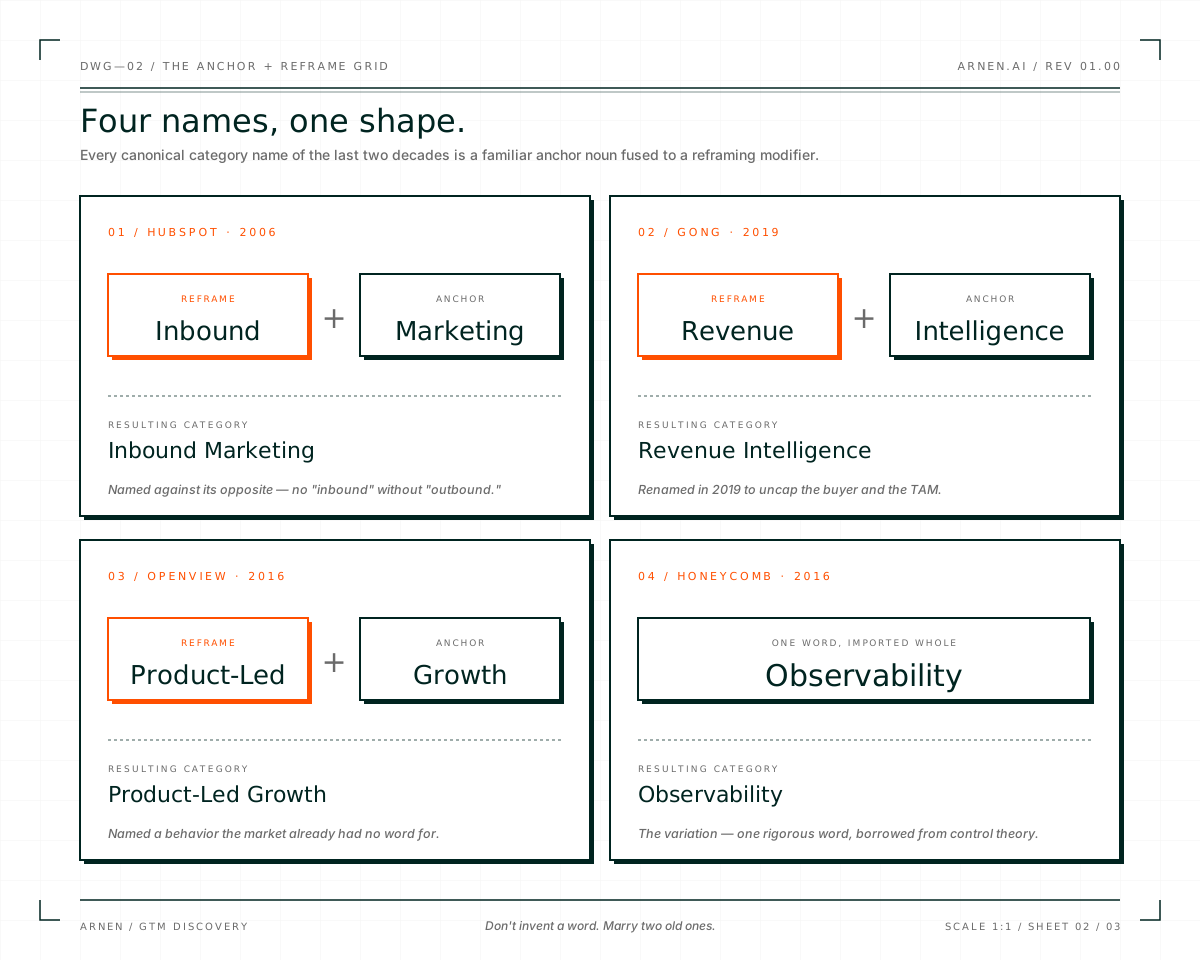
The canonical category names of the last twenty years are almost all this exact shape — a reframe modifier fused to an anchor noun:
- Inbound + marketing → inbound marketing (HubSpot)
- Conversational + marketing → conversational marketing (Drift)
- Revenue + intelligence → revenue intelligence (Gong)
- Product-led + growth → product-led growth (OpenView)
- Customer-data + platform → customer data platform (David Raab)
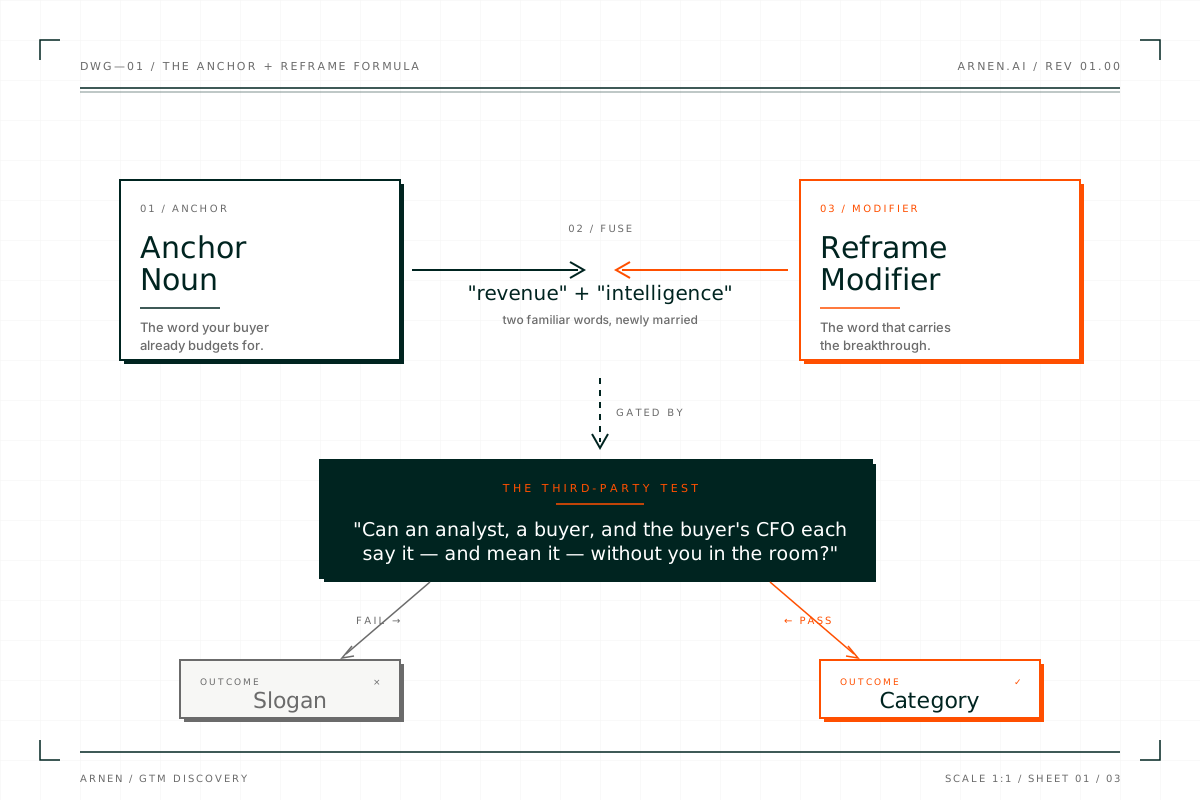
Get the balance wrong in either direction and the name fails. All modifier and no anchor — "agentic AI-native autonomous orchestration" — and the buyer's brain has nothing to file it under; it is four breakthroughs and no box. All anchor and no modifier — "marketing software" — and you have described a commodity with a thirty-year price war baked into it. The tension between the two words is the category. The anchor makes the name safe to think about; the modifier makes it worth thinking about.
And one hard constraint governs both words: neither may be invented. Each must already exist, with earned meaning, in a vocabulary the buyer respects — almost always their own, occasionally that of a credentialed adjacent field. The newness lives entirely in the combination, never in the words themselves. This is the deep reason category names cannot be coined — and the reason is not unfamiliarity but the absence of a prototype to borrow. A brand can afford to be a beautiful stranger, because a brand is protected by distinctiveness. A category name has to be a familiar face, because a category name is "protected" only by comprehension — and comprehension is the one property you cannot manufacture by inventing a word.
Part 3: The Linguistics of Stick
Two names can both follow the Anchor + Reframe formula and one will still spread while the other dies in committee. The difference lives below the level of meaning — in how the words sound, and how easily the brain processes them. Three findings from cognitive science turn naming from taste into engineering.
Processing fluency. The easier a phrase is to process, the truer, more familiar, and more credible it feels — a result the Trojan Horse piece drew on through Reber and Schwarz's fluency research. In 2006, the psychologists Adam Alter and Daniel Oppenheimer pushed the finding directly into names. Studying real markets, they found that stocks with pronounceable names and pronounceable ticker codes measurably outperformed disfluent ones in the days right after listing. Across the NYSE and AMEX, $1,000 placed in companies with pronounceable tickers returned roughly $85 more after a single day of trading than $1,000 placed in unpronounceable ones. Nothing about the underlying businesses differed. Only the ease of saying the name. A category name your buyer stumbles over pays a fluency tax on every single repetition — and a category spreads only by repetition. Disfluency does not announce itself. The buyer just feels a faint friction, files you under vaguely confusing, and moves on.
Sound symbolism. The specific sounds inside a name carry meaning before the meaning arrives. Richard Klink's research on brand naming showed that front vowels — the ee in "lean," the i in "quick" — connote smallness, lightness, speed, sharpness; back vowels — the o in "bold," the u in "rugged" — connote largeness, weight, solidity, slowness. The bouba/kiki effect, first observed by Wolfgang Köhler in 1929 and made famous by Ramachandran and Hubbard in 2001, found that about ninety-five percent of people, across wildly different languages and cultures, map the soft-sounding nonsense word "bouba" to a round shape and the hard-sounding "kiki" to a jagged one. Sound has a shape, and the shape is close to universal.
The most rigorous evidence here comes from brand naming — the opposite discipline, but the one that studies sound most carefully. When Lexicon Branding named the BlackBerry, its research held that the hard b connoted reliability and the short e connoted speed; the name tested as fast and trustworthy before anyone knew what the device did. A category creator cannot borrow brand naming's freedom to invent words — but can borrow its central finding: sound carries an argument of its own, and the name you choose should have its sound argue your case.
You will say your category name ten thousand times, so let its sound do some of the work. Say "conversation intelligence" and "revenue intelligence" aloud, back to back. One opens on a soft, slow, four-syllable word and sounds like a process. The other opens on a crisp word with a hard onset and a brisk rhythm and sounds like a decision. Gong's buyers were CROs, and CROs buy decisions — the category's own name should say so before the meaning arrives.
The Keats heuristic. In 1999, the psychologists Matthew McGlone and Jessica Tofighbakhsh found that people judged rhyming aphorisms — "Woes unite foes" — as more accurate than non-rhyming versions with identical meaning — "Woes unite enemies." Rhyme buys a hit of processing fluency that the brain misreads as truth. They named it the Keats heuristic, after the poet's claim that beauty is truth. You will rarely rhyme a category name itself — but the sentence that carries it, the point of view you repeat in every talk and post and sales call, can use rhythm, antithesis, and parallelism to borrow exactly that effect. "Different is better than better." The name itself stays plain; the sentence wrapped around it does the rhetorical work.
Part 4: Gong — The Name Is a TAM Decision
Return to Gong, because the rename only looked like a marketing refresh. It was a strategy decision — a decision about the size of the company Gong was allowed to become.
"Conversation intelligence" capped two things at once. It capped the buyer: the words pointed downward, at a sales-enablement manager who coaches reps, not at the CRO who owns the number. And it capped the use case: there are only so many things you can do with a recorded call. A category named after a mechanism inherits the mechanism's size, and a recorded call is a small mechanism.
"Revenue intelligence" uncapped both in a single move. Revenue is the widest noun in a go-to-market organization — it points at the CRO, the forecast, the board deck, the thing the whole company is measured on. And the use case it implies is no longer "review the calls" but "know whether you will hit the number," which quietly absorbs forecasting, deal inspection, pipeline management, coaching, and prospecting. Gong did not ship a five-times-bigger product on October 8th, 2019. It declared a five-times-bigger box, and then spent the following years growing into the box the word had drawn.
This is the hidden gem most founders walk straight past: the anchor noun in your category name sets the ceiling of your total addressable market. It is a TAM decision wearing the costume of a vocabulary decision. A product can outgrow its name — but never quietly; lifting the ceiling means a public rename, the expensive move Gong itself made on October 8th. Choose intelligence and you have license to annex the entire analytics surface of a function. Choose recorder and you are a feature forever, no matter how good the product gets. So before you fall in love with an anchor noun, run one test: when this category is mature and I am its king, how big is the box this word allows? If the honest answer is "small," you have found a feature name, not a category name. Naming yourself into a small box and then pricing yourself into that box's thin margins is the same failure the pricing piece in this series calls anchoring to an adjacent category — it just happens one layer earlier, in the noun.
Gong's second move mattered as much as the rename itself: it did not rename and hope. It worked the analysts until they ratified the word. When Gartner published a revenue-intelligence market guide — Gong's exact noun in the title — and Forrester built a Wave around the adjacent "revenue operations and intelligence," the category stopped being Gong's claim and became the industry's furniture. That is the precise moment a named category becomes real: not when the founder says it, but when someone the buyer already trusts says it back.
Part 5: Three Variations on the Formula
The Anchor + Reframe formula is constant. The mechanical lesson changes from case to case.
Inbound Marketing — name the motion, then build it a home. As Brian Halligan and Dharmesh Shah built HubSpot in the mid-2000s, Halligan coined "inbound marketing." Anchor: marketing — the oldest, safest budget line there is. Reframe: inbound — a direction. The quiet genius was choosing a word that only means something against its opposite: "inbound" forces the buyer to think "as opposed to outbound" — the interruptive cold-calling, list-buying motion every marketer was already exhausted by. The name argued HubSpot's case for it, before a single slide. Then HubSpot did the thing most category creators lack the patience for: it built the category a home. The 2009 book Inbound Marketing. The INBOUND conference — an annual gathering whose real job is to keep HubSpot the prototype of a word it had given away to everyone. By 2009 "inbound marketing" was running neck-and-neck with "content marketing" in search interest. Naming the category is the start of the work. You then have to host it.
Product-Led Growth — name what is already happening. In 2016 Blake Bartlett, a partner at the venture firm OpenView, noticed a pattern across his portfolio: companies were growing through the product itself rather than through a sales team or a marketing engine. He did not invent the behavior. He named it — "product-led growth" — and tested the phrase in public to see if it would stick. Anchor: growth, the thing every founder budgets attention for. Reframe: product-led, a claim about what does the leading. The lesson is liberating: the best category names are often observations, not inventions. You find a behavior the market is already exhibiting without a word for it, and you supply the word. The category was already there — ambient, real, and nameless. Bartlett's contribution was to make it sayable, and a thing that cannot be said cannot be chosen, funded, or scaled.
Observability — borrow legitimacy from another discipline. When Charity Majors and Christine Yen founded Honeycomb in 2016, they needed a word for what their product did that "monitoring" could not carry. They found it in control theory. In 1960, the engineer Rudolf Kálmán had defined observability as a measure of how well a system's internal states can be inferred from its external outputs. Majors borrowed the word wholesale — instead of marrying two everyday words, she imported one rigorous word from an adjacent, credentialed field.
This is the variation that deliberately bends the headline of this piece, and it is worth being precise about why it does not break it. No working ops engineer had "observability" in their vocabulary in 2016; Honeycomb spent years teaching it. So the rule from Part 2 was never "use only words the buyer already knows" — it was never invent. A category creator can teach a buyer a word that has a real definition and sixty years of engineering legitimacy behind it: there is a discipline to point at, a prototype to borrow. What a category creator cannot do is teach a coined word that has no meaning anywhere. The borrowed word arrives sounding like a discipline rather than a marketing department, because it was one. Snowflake ran a softer version of the same play by speaking in the decades-old, CIO-approved language of the "data warehouse." If your breakthrough has a structural cousin in a serious discipline, that cousin's vocabulary is sitting there, pre-legitimized, waiting to be annexed.
Part 6: The Naming Graveyard
Four failure modes, four ways a category name dies.
Failure one: naming the vendor instead of the value. The original word for cloud-delivered software was application service provider — ASP. The phrase names the company doing the providing; it tells the buyer nothing about what they get. The ASP era mostly collapsed for business-model reasons — single-tenant economics did not work — but the name was a separate, compounding failure: it never gave a buyer a reason to lean in. The successor, software as a service, named the buyer's new arrangement — software, delivered as a service, nothing to install. SaaS is now invisible furniture; ASP is a trivia answer. A category name must name the buyer's outcome or new arrangement, never your side of the transaction — the rule "conversation intelligence" half-broke and "revenue intelligence" repaired.
Failure two: the neologism. Founders fresh off naming their product — where an invented word is a genuine asset — try to coin their category the same way. It does not work. A coined category word ("phygital," and the long landfill of dead -tech and -verse compounds) hands the brain nothing to map: no prototype, filed under unknown. Inventing the words is not boldness; it is asking the buyer to do unpaid learning, and they will decline.
Failure three: the name you can own. The instinct to trademark the category name is the instinct to strangle it. A category name's whole job is to be repeated by people who do not work for you. Fence it off and no analyst will build a Wave around it, no competitor will validate it by adopting it, no buyer will find the reassuring second example that proves the category is real. A category with exactly one legal occupant is not a category — it is a product with a grand title and a lonely future.
Failure four: naming the category before you can be its prototype. Drift coined conversational marketing — a clean, well-formed Anchor + Reframe name — and the category genuinely took: HubSpot, Intercom, and others adopted the language. But adoption by competitors is also how a category gets crowded, and conversational marketing never produced the runaway prototype-king that revenue intelligence produced for Gong. Drift was acquired by Salesloft in 2024 and folded into a larger platform. The cautionary reading is not that the name was bad — it was good. It is that a category name is a promise you then have to spend a decade keeping. Coining the word is the cheap part. Becoming, and staying, the word's prototype is the work the word commits you to.
Part 7: Who Names It, and When
Who. If you do not name your category, someone else will — and naming rights are not neutral. The two parties most likely to name it for you are industry analysts and the press. The customer data platform was named by neither a vendor nor a journalist but by an analyst: David Raab coined "CDP" in a 2013 blog post, published the first CDP industry report, and founded the CDP Institute. That happened to work out — Raab is a careful definer — but it is a coin flip. When an analyst names your category, the analyst's definition and the analyst's quadrant boundaries arrive bolted to the name, and they may draw the box so your sharpest feature sits just outside it. The freemium model, by contrast, was named by the crowd: the venture capitalist Fred Wilson described the model on his blog in 2006, and a reader, Jarid Lukin, supplied the word. The lesson is not that analyst-naming or crowd-naming is bad. It is that the word will get named, with or without you — so the only real question is whether you author it or inherit it. The founder's job is to name it first, in public, and then recruit the analyst: to get Gartner and Forrester to write your noun into their report titles, the way Gong did.
When. Here the piece rejoins its predecessor. The Trojan Horse argued you should not name your category early — you should hide the breakthrough inside a familiar container, sell the saddle, and let the category name wait. That holds. Naming the category is a graduation move, and graduating too early is as fatal as never graduating. Name it before you have customers and you are evangelizing a word with no product underneath it — the single most expensive form of marketing there is. Name it too late and an analyst or a competitor names it for you, on their terms. The window opens when three conditions are true at once: you have enough customers that the pattern is undeniable; competitors are appearing, and the familiar-container frame has started to flatten you against them on price and features; and you can already see, concretely, the larger box you intend to grow into. When those three line up — and Gong's rename came four years after founding, not at launch — name it. Not before.
Part 8: Making the Name Travel
A category name is not announced. It is propagated.
Christopher Lochhead and the Category Pirates call the discipline languaging, and reduce it to three verbs: frame it, name it, claim it. Framing is the point of view the name rides on — the argument for why the old way is finished. Naming is the Anchor + Reframe word itself. Claiming is the repetition: the same noun, in every talk, post, briefing, and sales call, until it stops sounding like yours and starts sounding like the language. The name is the middle verb, and it is inert without the other two.
None of the winners simply put a new noun on a homepage and waited. HubSpot wrote the book and built the conference; Drift wrote the book; Gong worked the analysts until they printed the word themselves; Raab founded an institute. Each built a vehicle for the word — a book, an annual report, an event, a benchmark — because a category name moves only as fast as the artifacts that carry it. The noun on its own is a seed with no wind.
And carry it inside a sentence built for the ear — this is where the Keats heuristic earns its keep. The name stays fluent and plain; the point of view that carries it should have rhythm: antithesis, parallelism, the clean compression of a thing that sounds true because it sounds finished. The name is the cargo. The point of view is the truck. Build both.
Part 9: The Contrarian View
An honest piece has to steelman the strongest objection, and the strongest objection comes from the most rigorous voice in B2B positioning.
April Dunford does not think you should set out to create a category at all. Her position is blunt: companies do not create categories — categories emerge, and some companies are wise enough to notice. Her case is an economics case. To stand up a genuinely new category, you must persuade the buyer of two separate things — that the problem is real and that your kind of solution is the answer — which is roughly double the persuasion for the same single sale. Most startups run out of money, or patience, or investor goodwill, before the second argument lands. In Dunford's framework the market category is one input into positioning, not the starting point, and certainly not a trophy to chase.
She is right, and the correct response is not to wave her away — it is to absorb her. Three things follow from taking her seriously.
First: most companies should not try to create a category. They should find the category that is already emerging and name the emergence — which is exactly what Blake Bartlett did with product-led growth, and exactly the move Dunford herself endorses. Naming an emerging category is cheap; conjuring one from nothing is the expensive bet most founders should decline.
Second: Dunford's own description of a category name's job — to "trigger the correct assumptions in prospects' minds about your value" — is, read closely, a direct argument for the Anchor + Reframe formula. The anchor noun is the assumption-trigger. She and the formula are describing the same mechanism from two directions.
Third: her cost argument is the single best case for timing. Name the category late — after the Trojan Horse has already done the first half of the persuasion by selling inside a familiar container — and the name only ever has to carry the second half. The contrarian view does not refute category naming. It disciplines it: name fewer categories, name them later, and name them with words that do the buyer's thinking for them.
Part 10: Naming Meridian — A Worked Example
In the Trojan Horse piece, Meridian was a fictional AI-native compliance company. It went to market hidden inside a familiar container — positioned as "Vanta on autopilot," an autonomous agent that watches a company's production environment and generates audit evidence with no human in the loop. We left Meridian deliberately unnamed at the category level, because the Trojan Horse said the name should wait for the first fifty customers.
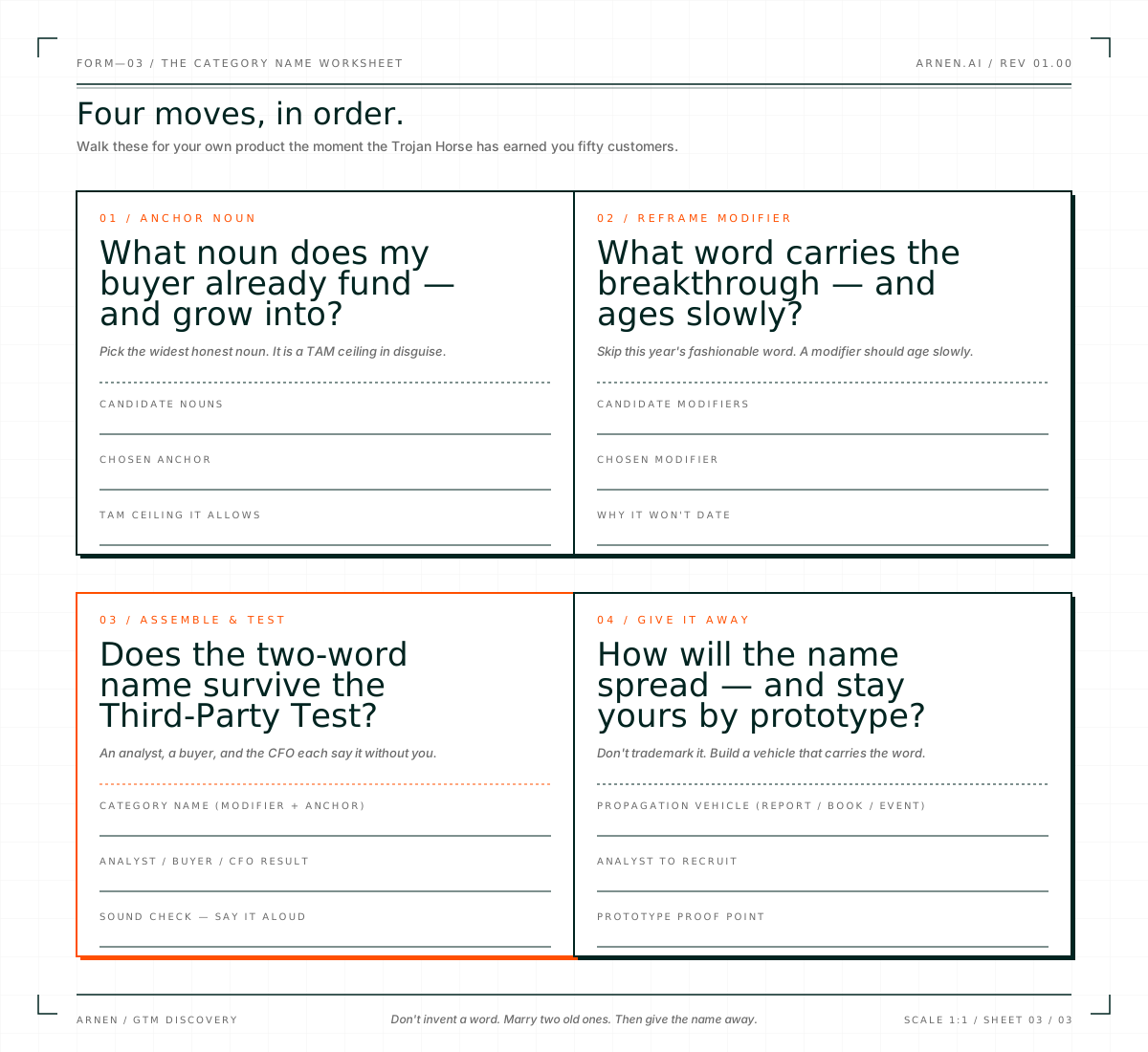
Meridian now has eighty customers, two unsolicited analyst inquiries, and a competitor that has started borrowing its language. The window from Part 7 is open. Walk the four moves.
Move one — choose the anchor noun. Meridian's buyer already budgets for "compliance automation." Candidate anchors: automation, compliance, GRC, audit. "GRC" is an analyst-owned acronym buyers tolerate but do not love. "Audit" is too narrow — it names a once-a-year event, not the ongoing thing. "Automation" describes the mechanism, not the value. Compliance is the widest honest noun the buyer already funds. Anchor: compliance.
Move two — choose the reframe modifier. The breakthrough is that evidence is generated continuously, by an agent, with zero human collection. Candidate modifiers: continuous, autonomous, agentic, self-driving. "Self-driving" is vivid but cartoonish for a compliance buyer — a CFO would smirk, and the name fails the test before it starts. "Agentic" is fashionable, and fashionable words age badly; a modifier should age slowly. That leaves two genuine finalists — continuous and autonomous — close enough that guessing between them is the wrong move. Finalists: continuous, autonomous.
Move three — assemble and stress-test the name. Two finalists reach this gate: continuous compliance and autonomous compliance. Run both through the Third-Party Test, and let the test — not taste — eliminate one.
Continuous compliance clears the first three gates cleanly. A Gartner analyst would title a report with it. A buyer can explain it to a CFO in one sentence: "compliance that never stops, instead of a once-a-year scramble." The CFO does not smirk. It even sounds right. And it fails anyway — on a criterion the three gates do not test. Two incumbents are already drifting into "continuous compliance" in their own marketing. Meridian could adopt it and the word would travel, but it would travel as furniture the incumbents built; Meridian would spend years propagating a word it can never be the prototype of. A name can pass every fluency and comprehension test and still be the wrong name, because the prototype slot behind it is already taken.
Autonomous compliance clears the same three gates — a report title, a one-sentence CFO explanation ("compliance that runs itself, no team uploading screenshots"), no smirk — and the prototype slot is open. It has two more things going for it: it borrows legitimacy from a credentialed adjacent field — autonomous vehicles — the move Honeycomb made with "observability," and it names the buyer's outcome (you do nothing) rather than the mechanism (an agent runs). Sound check: it opens on a weighty, four-syllable word that connotes seriousness and closes on the plain budget noun the buyer already funds; it scans like an operating posture, not a feature. The name is autonomous compliance.
Move four — give it away and propagate it. Meridian does not trademark "autonomous compliance." It does the opposite. It publishes The State of Autonomous Compliance, an annual benchmark built on its own corpus of customer audit data, and it uses the noun in every analyst briefing until Gartner and Forrester print it without being asked. The competitor already borrowing Meridian's language is not a threat to be lawyered — it is the category's second data point, the proof to the next buyer that the category is real. Meridian's job was never to own the words. It was to be the prototype the words point to.
The positioning artifact, updated from where the Trojan Horse left it:
Meridian is the autonomous compliance platform. We replace the screenshot-and-attest workflow with an agent that watches your production environment and generates audit evidence automatically — SOC2 readiness in 24 hours instead of 6 weeks.
Here is the worksheet, blank, for your own product:
Part 11: The Bottom Line
A category name looks like a small decision — a phrase on a homepage, one line in a pitch. It is the opposite of small. It sets the size of the box you can grow into, the budget line you can be funded from, the analysts who will or will not write about you, and the speed at which the rest of the market can repeat what you do without you in the room.
The founders who named well — Gong, HubSpot, OpenView's framing of product-led growth, Honeycomb — did not coin clever words. They married familiar ones. They chose anchor nouns big enough to grow into. They tuned the sound until the phrase argued its own case before the meaning arrived. And then they gave the name away and spent a decade being its best example.
You cannot invent a category name. The market has to be able to say it without you, file it next to things it already knows, and explain it to someone who controls a budget. So do not invent a word. Marry two old ones — one the buyer already funds, one they have never heard applied this way — make the marriage sound inevitable, and then hand it to everyone.
That is how you name a category nobody has a word for yet.
Arnen pressure-tests Anchor + Reframe candidates — scored for fluency, for the size of the TAM box the anchor allows, and for whether they survive the Third-Party Test. But the four moves in this piece work on a whiteboard too: run your own category name through them before you commit to it.
Sources
Category creation and its value:
- Why It Pays to Be a Category Creator — Eddie Yoon & Linda Deeken, Harvard Business Review (2013)
- Becoming a Category King with the Play Bigger Team — S2G (the 76% statistic)
- Languaging: The Strategic Use of Language — Christopher Lochhead
Cognitive science and linguistics of naming:
- Predicting Short-Term Stock Fluctuations by Using Processing Fluency — Alter & Oppenheimer, PNAS (2006)
- Study: Stock Performance Tied to Ease of Pronouncing a Company's Name — Princeton (2006)
- Creating Brand Names with Meaning: The Use of Sound Symbolism — Richard Klink (2000)
- The Bouba/Kiki Effect — Köhler (1929), Ramachandran & Hubbard (2001)
- The Keats Heuristic: Rhyme as Reason in Aphorism Interpretation — McGlone & Tofighbakhsh (1999)
- The Man Who Named BlackBerry, Swiffer and Dasani — CNN Business
The case studies:
- What Is Revenue Intelligence? Why Gong Pioneered the Category in 2019 — Gong
- HubSpot CEO Brian Halligan on the Evolution of Inbound Marketing — MarTech
- How Product-Led Growth Went from Idea to the Biggest Trend in Software — OpenView
- Observability: The 5-Year Retrospective — Honeycomb
- The Pre-History of Software as a Service — SmartBear (ASP to SaaS)
- The CDP Institute Backstory — David Raab and the naming of the Customer Data Platform
- Freemium — origin of the term (Fred Wilson, Jarid Lukin, 2006)
- Drift Acquired by Salesloft — MarTech
The contrarian view:
Build your GTM strategy in weeks
Arnen analyzes 10,000+ companies to discover your pricing, narratives, and objection patterns. Start with a free hypothesis in 48 hours.